“Things fall apart; the centre cannot hold,” wrote William Butler Yeats in his poem, “The Second Coming”. Yeats was writing about the atmosphere in post-war Europe, sure, but he could equally have been talking about Disney+’s Rivals, which returns this week with six episodes to conclude its second series. With so many extramarital dalliances being juggled, can the balls of Rutshire’s randy residents stay airborne? Or will mere anarchy be loosed upon the world?
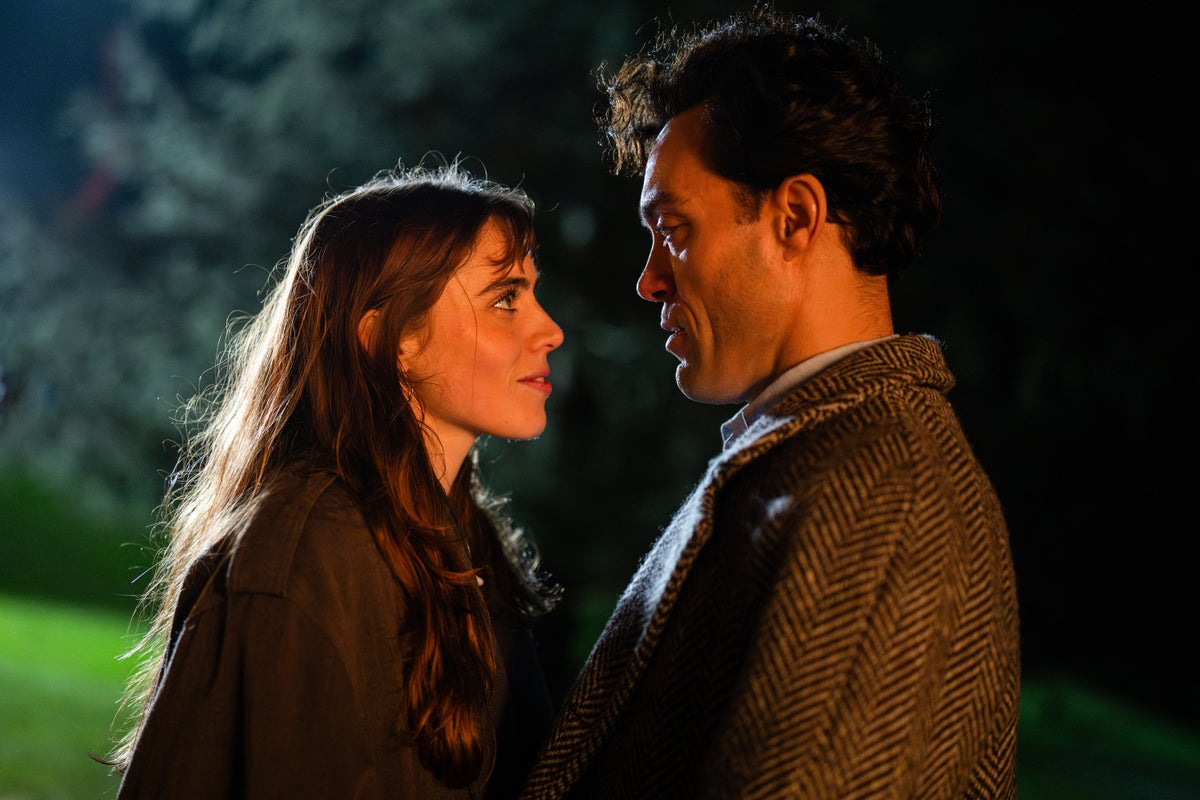
Monica Baddingham (Claire Rushbrook) is dead. Having uncovered the infidelity of her husband Tony (David Tennant), she was struck down in a storm that swept through the county. But the repercussions of her death go beyond Lord Baddingham’s estate. Will Declan O’Hara (Aidan Turner), whose Yeats documentary has finally aired, discover that his wife, Maud (Victoria Smurfit), has been cheating on him with his greatest rival? Will smutty author Lizzie (Katherine Parkinson) and tech magnate Freddie (Danny Dyer) survive their guilt, as their connection becomes a full-blown affair? And who is the mole within the Venturer camp, whose constant leak of information to Corinium threatens their franchise bid? “There’s probably been a sleeper since we started,” observes Rupert Campbell-Black (Alex Hassell), as he surveys the, apparently innocent, faces in front of him.
All of that is well and good. Rivals is a high-class soap opera, with slightly racier sex scenes. At times, keeping your eye on the myriad adulteries is like watching a magician manipulate a ball between a set of cups (“wait,” I found myself thinking, “whose baby is she actually having?”) but that’s true to the world that the late Jilly Cooper created. Characters like Nafessa Williams’s Cameron Cook come and go when the plot needs them. When her sexual intrigue with Tony Baddingham was done, she was moved over to Rupert Campbell-Black. Now, with Rupert gone cold, she heads back to America, only to be reeled in for the reemergence of O’Hara Jr, Declan and Maud’s son Patrick (Gabriel Tierney). Her role is illustrative of the utter narrative pragmatism of the show. “There’s sex, social commentary and a slow-burn romance,” Lizzie, a proxy for Cooper within her own universe, reveals of her latest book. The first two of those things, Rivals does really rather well. It is saucy and biting, unafraid to lampoon Thatcherite Britain.
But here we must inevitably arrive at the Taggie Problem. Taggie O’Hara (Bella Maclean) is, in some ways, the show’s romantic lead. She is the person who can tame the wild stallion, Rupert Campbell-Black. The issue is that, set against a cast of engaging, technicolour characters, Taggie is utterly monochrome. Her personality appears to be: having big eyes, making nice canapés, and being dyslexic. That was tolerable while she represented a foil for Rupert’s excesses, but now the show is pushing them, inexorably, together. They are, to use a term from modern fandom, endgame. Their slow-burn romance (“have you taken that girl’s virginity yet?” Monica’s horrible sister, Minty (Rachael Stirling), asks bluntly but fairly) has neutered the show’s most fun character by pairing him off with the most boring one.
It’s a shame that so much of this second season’s climax is wasted on Rupert and Taggie, because the other couples are an eclectic mix of the morally questionable and the downright evil. The tryst between Lizzie and Freddie feels like a surprisingly genuine depiction of the moral quagmire of adultery, while the disintegration of the O’Haras’ marriage is played with the sort of melodramatic intensity usually reserved for the final seconds of an EastEnders episode. Other storylines – such as the marriage of Gerald (Hubert Burton) and Muffy (Eliot Salt), while his love story with Charles (Gary Lamont) withers in the shadow of the Aids crisis – have so much depth and pathos, that it feels a shame to see them buried beneath a “will they, won’t they” which has never had any real tension. It’s a strength and weakness of Rivals that the show has so many excellent characters. It fills Rutshire with possibilities for intrigue, but results in some relationships getting a bit lost, like a single male divorcee at an orgy.
The decision to split this second series in two was a bizarre one, surely motivated by the streamer’s financial model. With six episodes in each half, and six months between them, they feel materially separate. But even if the Walt Disney Company is engaging in shenanigans to maintain high subscription levels, Rivals is still an accomplished, jolly romp through the Sloane Ranger culture of the 1980s. That said, the show needs to remember that the more compromised its characters are, the more fun its audience is having.